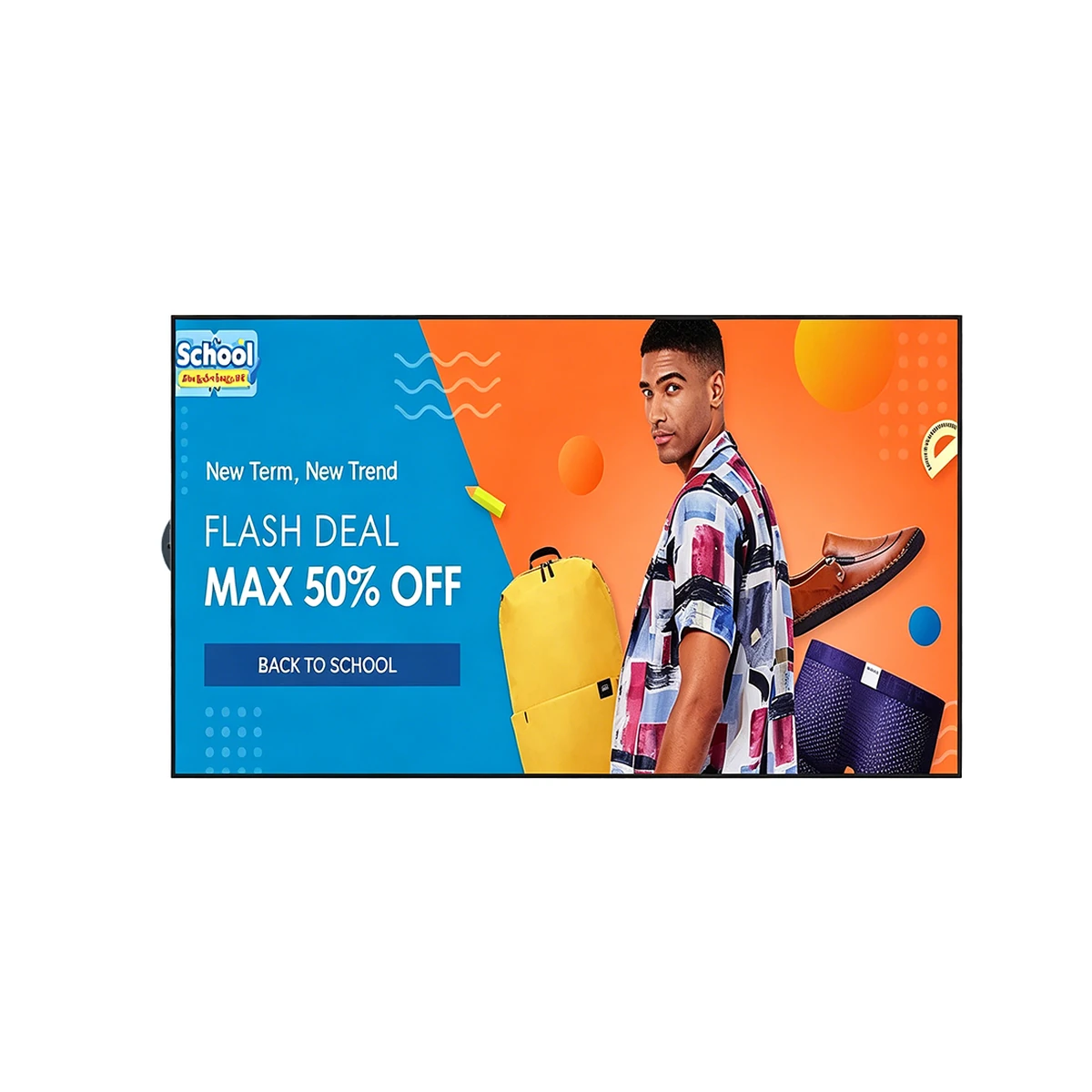
High-street retail window
Start with: High-bright portrait or landscape display installed behind glass.
Verify: Midday reflection, ventilation and landlord mounting limits.

Window touch screen for storefront glass mounting
Storefront digital display and window touch screen designed to mount directly onto retail glass — readable from the street while showing inventory, promotions and brand stories. Specifications coming soon; contact us for current quote.
Models in this line
Buyer specification guide
Use deployment conditions and integration requirements to narrow the product line before comparing unit price.
For a storefront window display, measure street-facing light and the heat trapped behind the glass before choosing screen size. A high-bright panel, controlled ventilation and an anti-reflection strategy usually matter more than adding touch, especially when pedestrians cannot physically reach the inside surface.
Current comparison points: Sizes: 43"-75"; Brightness: 2500-3500 nits; Platform: RK3566 / Android 11; Protection: IP43. Validate the shortlisted configuration with the actual content, mounting method and ambient conditions before volume production.
For a storefront window display, measure street-facing light and the heat trapped behind the glass before choosing screen size. A high-bright panel, controlled ventilation and an anti-reflection strategy usually matter more than adding touch, especially when pedestrians cannot physically reach the inside surface. The current line should be compared on Sizes: 43"-75"; Brightness: 2500-3500 nits; Platform: RK3566 / Android 11; Protection: IP43.
The current Window Display line covers 43"-75". Confirm the exact active area, outer dimensions and mounting drawing for the selected model before ordering.
Yes. Wintouch can review enclosure, logo, colour, I/O, firmware, touch, brightness, packaging and certification requirements. A production-equivalent sample should be approved before volume manufacture.
Procurement checklist
For a storefront window display, measure street-facing light and the heat trapped behind the glass before choosing screen size. A high-bright panel, controlled ventilation and an anti-reflection strategy usually matter more than adding touch, especially when pedestrians cannot physically reach the inside surface.
Use 2500-3500 nits for bright storefronts and confirm performance with real campaign content.
Window reflections reduce apparent contrast and can hide dark creative even when the panel itself is high-brightness.
Maintain an air gap and ventilation path; verify the window cavity temperature at midday.
Solar energy passes through the glass and can create a hotter microclimate than the outdoor air temperature suggests.
Approve glass clearance, suspension or wall brackets, portrait/landscape orientation and service route.
A display installed too close to the window can overheat and create a visible double reflection.
Choose remote scheduling, automatic brightness and an outage recovery policy for every location.
Window networks are difficult to access after store hours and failed screens are visible from the street.
Start with: High-bright portrait or landscape display installed behind glass.
Verify: Midday reflection, ventilation and landlord mounting limits.
Start with: Networked display sized for a longer pedestrian viewing distance.
Verify: Text size, scheduling permissions and 24/7 operating policy.
Start with: Touch only after confirming access side and through-glass touch feasibility.
Verify: Glass thickness, controller tuning, weather boundary and accessibility.