
- Published
- Reading time
- 7 min read
Outdoor Digital Signage Buyer's Guide 2026: Nits, IP Ratings & Smart City Deployments
A B2B procurement guide to outdoor digital signage in 2026: brightness (nits), IP ratings, thermal management, mounting options, and smart city deployment requirements. Includes spec comparison tables and five-question pre-RFP checklist.
On this page
What compliance evidence should a display buyer request?
CE is an EU conformity marking, not a single certificate; applicable display rules commonly include EMC and RoHS. FCC authorization covers radio-frequency devices and unintentional radiators sold in the United States, while RoHS limits specified hazardous substances in electrical and electronic equipment. Before ordering, request the exact model’s EU Declaration of Conformity, referenced laboratory reports, FCC ID or authorization record when applicable, RoHS test report or material declaration, and verify any notified body in NANDO.
In 30 Seconds: The Outdoor Signage Spec That Matters
Outdoor digital signage in 2026 demands at least 2,500 nits brightness for direct-sun readability, IP65 or higher weatherproofing, and an operating range of -20°C to 50°C with active thermal management. The fastest-growing segment — battery-powered outdoor posters — eliminates civil works entirely, while smart-city RFPs increasingly bundle displays with 5G small cells and public Wi-Fi. Before you issue an RFP, define your deployment climate, ambient light, power availability, and uptime SLA. The spec sheet flows from there.
The Real Cost of Getting Outdoor Signage Wrong
A QSR chain deploys 50 outdoor menu boards across Southeast Asia. Six months in, ten units show condensation inside the enclosure; five are unreadable by 2 PM under direct sun. The procurement manager learns the hard way: outdoor signage isn't indoor signage in a metal box. It's a thermal, optical, and mechanical engineering problem.
This guide walks B2B buyers — procurement leads, system integrators, and project managers — through the four non-negotiable dimensions of outdoor digital signage specification: brightness, IP rating, thermal management, and mounting architecture. Plus the two tailwinds reshaping procurement in 2026: smart-city RFPs and battery-powered deployments.
1. Brightness: The Non-Negotiable
Sunlight at noon delivers approximately 10,000 nits of ambient brightness. An indoor display (200–400 nits) reflects more light than it emits. Here's what you actually need:
| Deployment Scenario | Minimum Nits | Recommended Nits | Technology Required |
|---|---|---|---|
| Shaded outdoor (under awning) | 1,000 | 1,500 | High-brightness backlight |
| Partial sun (morning/evening) | 1,500 | 2,000 | High-brightness + anti-glare |
| Full direct sun (noon, desert) | 2,500 | 3,000+ | High-brightness + optical bonding |
| Drive-thru (angled toward driver) | 2,500 | 3,000 | Optical bonding + auto-dimming |
Optical Bonding: The Brightness Multiplier
A 2,500-nit panel with air-gap bonding performs like 1,800 nits — light reflects between LCD and cover glass. Optical bonding eliminates the air gap with resin, cutting reflectance by up to 70%. For any deployment facing direct sun, optical bonding is not optional — it's the difference between readable and invisible.
We covered the nit-selection decision in depth: 1500 Nits vs 2500 Nits: How Bright Does Your Outdoor Kiosk Display Need to Be.
Ask your supplier: "Is this 2,500 nits after optical bonding, or panel-only brightness? Provide a photometer reading at 100,000 lux."
2. IP Rating: The Seal That Defines Service Life
The IP (Ingress Protection) code defines dust protection (first digit) and water protection (second digit). An outdoor enclosure is only as good as its weakest gasket.
| IP Rating | Dust | Water | Typical Deployment |
|---|---|---|---|
| IP54 | Partial | Splash | Covered walkway, indoor-outdoor transition |
| IP65 | Total | Low-pressure jets | Drive-thru, bus stop, retail window |
| IP66 | Total | Powerful jets | Monsoon region, car wash, coastal |
| IP67 | Total | 1m submersion | Flood-prone area, marine deck |
| IP69K | Total | High-pressure steam | Food processing, pharmaceutical cleanroom |
For most commercial outdoor signage — QSR drive-thru, bus stops, retail window posters — IP65 is the baseline. For Southeast Asian monsoons or Middle Eastern sandstorms, IP66 with scheduled gasket inspections is prudent.
Full breakdown by industry: IP65 vs IP67 vs IP69K: Which Display Rating Does Your Industry Need?
Reality check: IP certification is a lab test. A 3-year-old IP65 enclosure in Riyadh (50°C, fine sand) is not the same as one in London. Budget for seal replacement every 24–36 months in harsh climates.
3. Thermal Management: The Silent Killer
LCD panels have a narrow comfort zone. Below -20°C, liquid crystals slow — image ghosting. Above 50°C, the backlight degrades and the panel blackens.
| Thermal Strategy | Temperature Range | Best For |
|---|---|---|
| Passive (heatsink) | -10°C to 40°C | Temperate climates, shaded installs |
| Active (fans + heatsink) | -20°C to 50°C | Desert, tropical, direct-sun |
| Heater + active cooling | -40°C to 55°C | Nordic, Canadian, Middle East extremes |
A unit spec'd for "0–50°C" in Shenzhen will fail in Dubai in July. Always specify the temperature envelope for your deployment geography — and verify the supplier can produce thermal chamber test reports.
4. Mounting Architecture: Wall, Floor, or Mobile?
Outdoor signage isn't one form factor. The deployment scenario dictates the mount:
Wall-Mount: Permanent, Always-On
Aluminum-profile enclosures with 3mm+ tempered glass. VESA mounting ensures third-party bracket compatibility. At 1,000 nits (optional), they handle shaded outdoor conditions; specify high-brightness backlight for full-sun exposure.
Floor-Stand: High-Traffic, Interactive
Floor-standing kiosks straddle signage and interaction — wayfinding in transit hubs, self-service in retail. Portrait (9:16) orientation matches smartphone-native layouts.
Battery-Powered: No Trenching Required
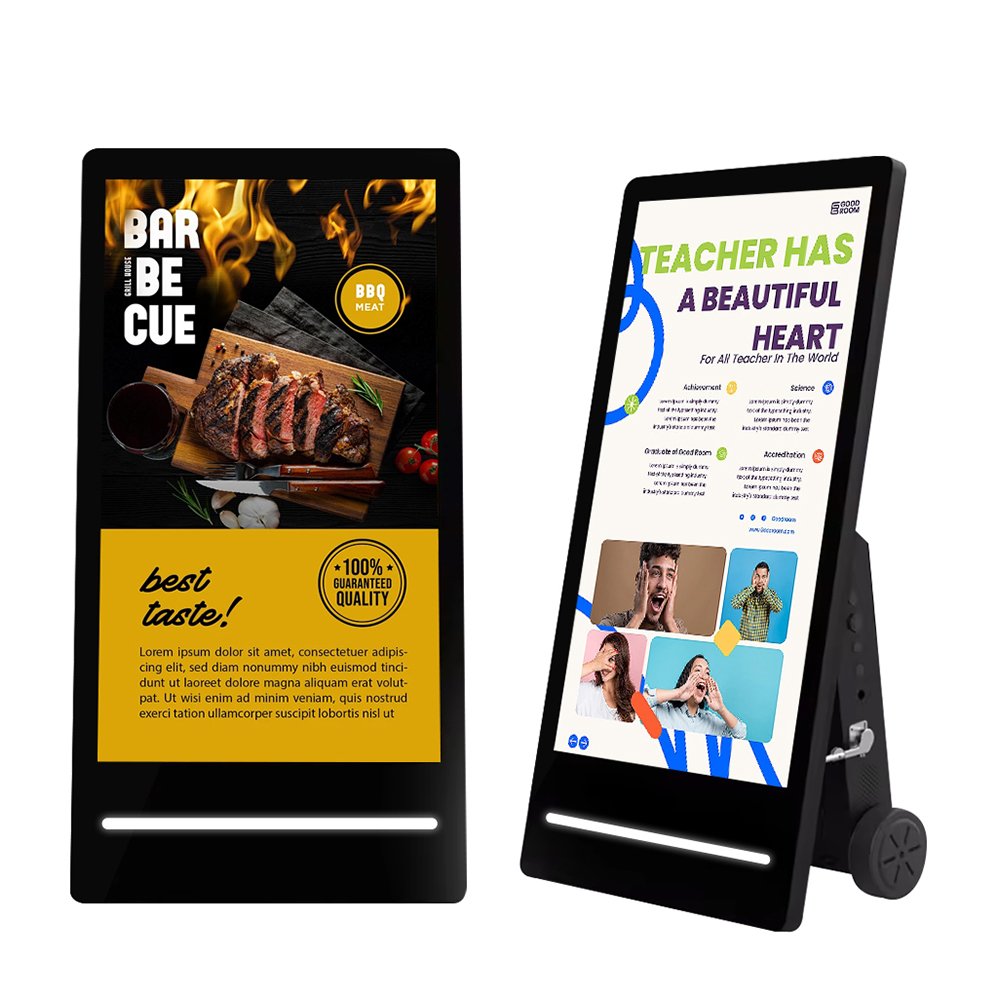
The fastest-growing segment. Battery-powered outdoor posters eliminate civil works — no trenching, no conduit, no electrical permits. A 45–55 Ah battery on a 32" unit delivers 8–10 hours of continuous playback. Swappable battery trays extend runtime indefinitely.
5. Smart City & DOOH: The Biggest Tailwind
The global digital-out-of-home (DOOH) market reached $182 billion in 2025 with an 11.3% CAGR. The US Infrastructure Investment and Jobs Act allocated $65 billion to digital infrastructure — a portion of which flows into smart-city display deployments.
- RFP volumes are rising. Smart-city tenders now bundle outdoor displays with sensors, 5G small cells, and public Wi-Fi.
- Programmatic DOOH demands uptime. Ad networks require 99.5%+ — shifting procurement from "cheapest unit" to "lowest total downtime."
- Energy efficiency is a procurement filter. EU Ecodesign and California Title 20 push municipal buyers toward sub-500W consumption at 75".
6. The Five-Question Pre-RFP Checklist
Answer these before you talk to any supplier. Each answer directly determines a specification dimension:
- Peak ambient brightness at the install location? — Use a lux meter at noon. This defines your minimum nit requirement. A shaded bus shelter in London needs 1,500 nits; a sun-facing wall in Dubai needs 3,000+ with optical bonding.
- Climate envelope: minimum and maximum temperature, humidity, salt, and sand exposure? — This defines your IP rating tier and thermal management strategy. Coastal deployments add salt-fog corrosion risk; desert deployments add fine-sand ingress.
- Is line power available at the install point? — If no, specify battery + solar hybrid. Factor in the cost of avoided trenching against battery swap logistics.
- What uptime SLA does the deployment require? — DOOH ad networks typically demand 99.5%+. This means redundant power supplies, remote monitoring (SNMP or proprietary CMS), and a defined service-response window.
- Who maintains the units post-installation? — Internal facilities team or third-party integrator? This determines CMS complexity, remote-diagnostics requirements, and whether the spec needs tool-free service access.
7. Certifications That Matter for B2B Procurement
- CE (EMC + LVD) — Mandatory for EU market access. Covers electromagnetic compatibility and low-voltage safety directives.
- FCC Part 15 — US electromagnetic compliance. Required for any device with a clock oscillator above 9 kHz entering the US market.
- IEC 62368-1 — Safety standard for IT/AV equipment, replacing IEC 60065 and IEC 60950-1. Required for CE marking of displays.
- IK10 — Impact resistance rating for vandal-prone public areas. IK10 = 20 joules (5 kg dropped from 40 cm). Spec this for transit hubs and unsupervised outdoor locations.
For EU and North American buyers: confirm the supplier ships with CE + FCC by default. Ask for test reports — not just the logo on the label.
Frequently Asked Questions
How many nits does an outdoor digital signage display need?
At minimum 2,500 nits for direct-sun readability. Shaded installations (under awnings, covered walkways) can function at 1,500 nits. For desert or tropical deployments with full noon-sun exposure, specify 3,000+ nits with optical bonding to minimize internal reflections between the LCD and cover glass.
What IP rating is required for outdoor digital signage?
IP65 is the commercial baseline — total dust protection and resistance to low-pressure water jets. For monsoon regions, coastal installations, or car-wash-adjacent locations, specify IP66. For flood-prone areas or marine decks, IP67. Food-processing facilities require IP69K for high-pressure steam cleaning.
How long do outdoor digital signage displays last?
A properly specified outdoor display with IP65+ enclosure, active thermal management, and scheduled gasket replacement (every 24–36 months) should deliver 50,000+ hours of backlight life — approximately 5–7 years of continuous operation. The primary failure modes are seal degradation (water ingress), backlight dimming from heat stress, and power-supply failure from thermal cycling.
Can outdoor digital signage run on battery power?
Yes. Battery-powered outdoor posters are the fastest-growing segment in 2026. A 45–55 Ah lithium battery on a 32" unit delivers 8–10 hours of continuous playback. Swappable battery trays or solar-hybrid configurations extend runtime indefinitely without trenching or electrical permits.
What certifications should I require from my outdoor display supplier?
For EU deployments: CE (EMC + LVD) and IEC 62368-1. For US: FCC Part 15. For public-area vandal resistance: IK10. Always request test reports from an accredited lab (TÜV, SGS, Intertek) — not just a logo on the spec sheet. For municipal smart-city tenders, also verify ISO 9001 and BSCI factory audit reports.
Spec Your Outdoor Display
Outdoor digital signage procurement rewards specificity. The more precisely you define the deployment environment — climate, ambient light, power, uptime SLA — the fewer post-installation surprises.
Request a specification and quote from an engineer who's shipped outdoor displays to your target market. One business day reply, reviewed at our Dongguan plant.
Further Reading (Content Cluster)
- IP65 vs IP67 vs IP69K: Which Display Rating Does Your Industry Need?
- 1500 Nits vs 2500 Nits: How Bright Does Your Outdoor Kiosk Display Need to Be?
- Industrial Touch Monitor Selection Guide: Optical Bonding, Sunlight Readability & More
- 2026 Commercial Display Buyer's Guide — 5 Critical Dimensions for B2B Buyers
Sources and standards
External standards and procurement guidance used to verify terminology and buyer criteria in this article.
- IEC 60529: Degrees of protection provided by enclosures (IP Code) — International Electrotechnical Commission
- Purchasing Energy-Efficient Displays and Monitors — U.S. Department of Energy
- Directive 2014/30/EU on electromagnetic compatibility — EUR-Lex, European Union
- Directive 2011/65/EU on restricted substances in electrical and electronic equipment — EUR-Lex, European Union
- Notified bodies and the NANDO database — European Commission
- Equipment authorization procedures — Federal Communications Commission
- Safety Gate, the EU rapid alert system for dangerous non-food products — European Commission
Wintouch Engineering Team
Our commercial-display engineers and product team review specifications against current factory records, deployment requirements and published standards. Learn more about our engineering capability and manufacturing operation.
Continue researching
Product facts and engineering claims follow our data and editorial policy.
Have a deployment question?
Share your environment, screen size and integration requirements with our engineering team.