
- Published
- Reading time
- 5 min read
Wall-Mounted Advertising Displays for Retail, Restaurants and Commercial Spaces
A practical guide to wall-mounted advertising displays for retail, restaurants and commercial spaces: real applications, screen-size and brightness selection, orientation, touch, CMS and a buying checklist for B2B buyers.
On this page
What Is a Wall-Mounted Advertising Display?
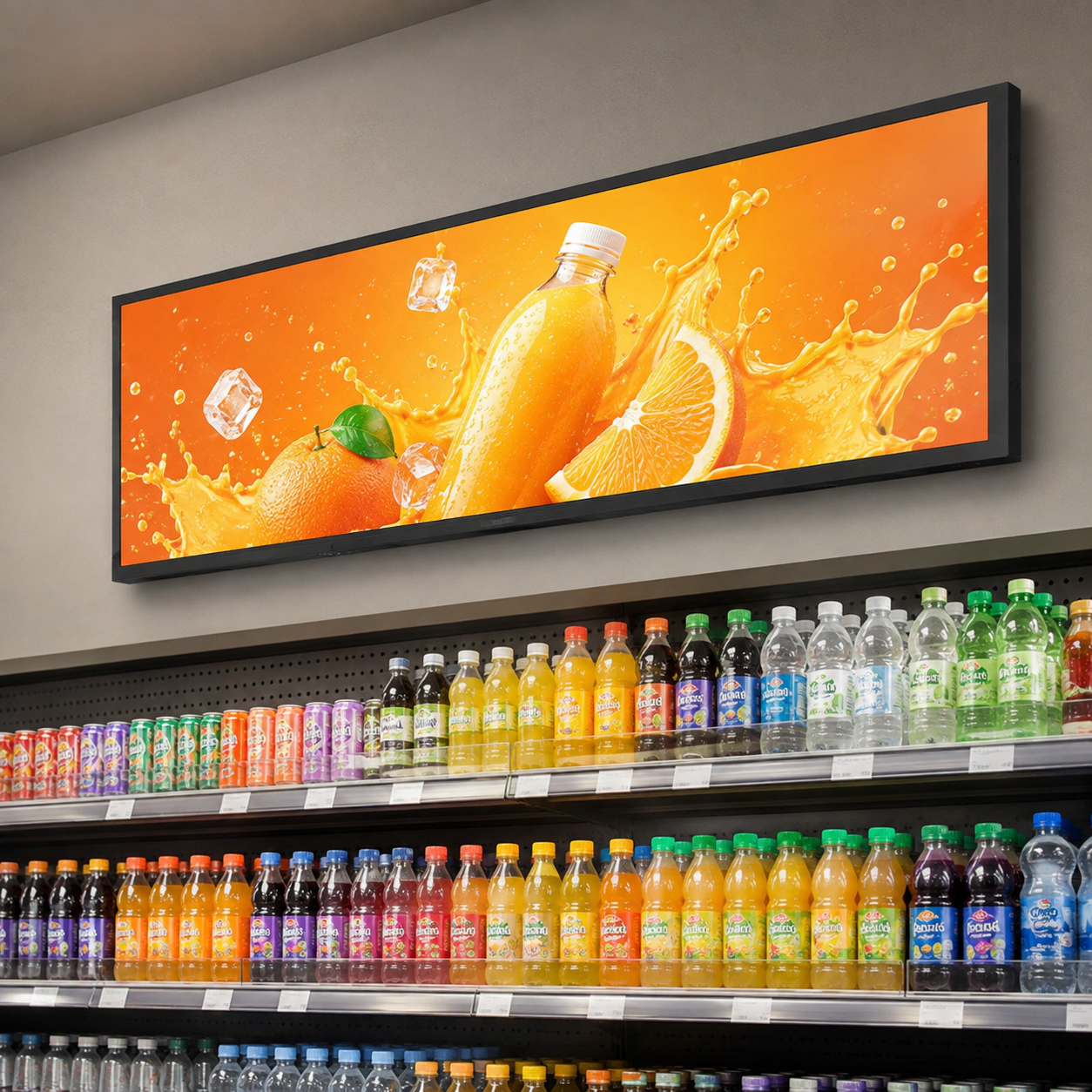
A wall-mounted advertising display is a commercial-grade LCD screen built to be permanently fixed to a wall or partition and run promotional content for 16 to 24 hours a day. Unlike a consumer TV, it is rated for continuous duty, holds a calibrated brightness for years, supports portrait or landscape orientation, and can be driven by a built-in Android player or an external media player. For retail, restaurants and commercial spaces it is the cheapest way to reach customers already inside the building — no media buy, no per-impression cost, full control of the message.
Why Wall-Mount Instead of Floor-Standing or Freestanding
The decision is usually about floor space and sightlines, not budget. A wall-mounted unit costs less to ship, less to install, cannot be knocked over by foot traffic, and takes zero usable floor area — which matters when every square metre is either a shelf or a table. The trade-off is that installation is permanent: you need the right wall, the right bracket, and a plan for power and network before the screen arrives.
Where floor space is available and the goal is a focal point (a flagship window, a hotel lobby), a floor-standing solution often wins. Where the goal is a message repeated along a wall — aisle-end offers, menu boards, wayfinding — wall-mounting is almost always the right answer.
Where Wall-Mounted Displays Actually Earn Their Keep
| Environment | Typical use | What breaks if you get it wrong | Priority spec |
|---|---|---|---|
| Retail stores | Promotions, new arrivals, price campaigns | Screen too dim to read under store lighting; no CMS means weekly USB trips | 500+ nits, portrait capable, CMS |
| Restaurants / QSR | Digital menu boards, combo upsells | No duty rating → panel failure in months; no local storage → menu dies when Wi-Fi drops | 16/7+ duty, offline playback |
| Hotels | Lobby welcome, meeting-room signage, F&B promotion | Fixed orientation looks wrong in portrait lobbies; visible bezel cheapens the brand | Slim bezel, portrait/landscape |
| Corporate offices | Reception content, internal comms, KPI dashboards | No scheduling → stale content; no remote access → IT can't update it | Scheduling, network control |
| Clinics & pharmacies | Health campaigns, queue info, OTC promotion | Glossy panel glares under clinical lighting; volume too loud | Anti-glare, adjustable audio |
| Gyms & showrooms | Class timetables, product loops, brand films | Weak brightness washed out by windows | 700+ nits, 4K for close viewing |
| Banks & service counters | Rate boards, product explainers, queue calls | No touch → static messaging only | Optional touch, reliable driver board |
| Exhibitions & events | Booth loops, sponsor reels | Long lead time misses the show date; no VESA standard → bracket doesn't fit | Standard VESA, short lead time |
Screen Size and Placement: Get the Viewing Distance Right First
Most buyers choose size by looks; the correct method is viewing distance. A practical rule for 1080p content is a minimum distance of roughly 1.5× the screen height, and a comfortable distance of 2–3×. For 4K, you can sit closer before pixels become visible.
| Screen size (16:9) | Typical wall placement | Comfortable viewing distance |
|---|---|---|
| 18.5"–24" | Counter ends, shelf edges, lifts, fitting rooms | 0.7–1.5 m |
| 27"–32" | Reception, meeting-room doors, pharmacy windows | 1.2–2.5 m |
| 43"–50" | Menu boards, aisle ends, gallery walls | 2–4 m |
| 55"–65" | Store entrances, lobbies, canteens, showrooms | 3–6 m |
| 75"+ / 4K | Feature walls, big lobbies, showroom hero | 4–8 m |
Height matters as much as size. The centre of the screen should sit at roughly 1.2–1.5 m for standing viewers, or 1.0–1.2 m where the audience is seated. A menu board mounted at consumer-TV height is one of the most common installation mistakes we see.
Brightness, Resolution and Duty Rating
These three numbers decide whether a display still looks right in year three.
- Brightness (nits): 300–400 nits is fine for a dim interior facing away from windows. 500–700 nits is the safe default for retail and restaurants. Above 1,000 nits is for window-facing or outdoor installation, and it costs significantly more.
- Resolution: 1080p is enough for anything viewed beyond two metres. Choose 4K when the audience stands close, when the screen is large, or when the content carries fine text such as pricing or dashboards.
- Duty rating: a consumer TV is designed for a few hours a day. A commercial panel is specified for 16/7 to 24/7. Content that runs from open to close is 12–16 hours a day — already beyond consumer design intent.
Portrait or Landscape?
Modern commercial panels support both, but check two things before ordering: that the panel is rated for portrait orientation (some panels run hotter vertically), and that the content platform supports a 9:16 canvas without stretching. Portrait suits menu boards, directory lists, fashion photography and narrow wall sections. Landscape suits video, wide promotions and dashboards.
Do You Need Touch?
Touch roughly doubles the unit cost, so justify it with a use case. Projected-capacitive (PCAP) touch is the standard choice for interiors — it is responsive, supports multi-touch, and works behind a bonded glass front. Resistive touch is cheaper but feels dated and suits gloved or industrial environments. Infrared touch works through a frame and is common on very large interactive walls but adds depth and collects dust on the emitters.
Choose non-touch when the display is purely an advertising surface — most retail promotions, menu boards and lobby screens never need it.
The Content Layer: CMS and Playback
A display without a content system is a cable and a USB stick. For anything beyond a single screen, buyers should have a CMS that supports remote scheduling, multi-screen groups, playlists, proof-of-play reporting and automatic restart if the network drops. Built-in Android players handle this without extra hardware; external players remain an option where a corporate platform already exists.
Whichever route you take, insist on offline playback: content cached on the device so that a Wi-Fi outage shows yesterday's promotion instead of a black screen.
Buying Checklist Before You Order
| Check | What to ask | Red flag |
|---|---|---|
| Panel grade | Which panel grade, and is it stated in the quote? | "A-grade" with no source named |
| Duty rating | What hours-per-day is the panel specified for? | Consumer rating reused for signage |
| Brightness | Measured nits, or just "high brightness"? | No nits figure at all |
| Orientation | Is portrait officially supported? | "Should be fine" |
| Player / OS | SoC, RAM, storage, Android version, GMS? | Unnamed chipset |
| Mounting | VESA pattern and bracket included? | Non-standard fixings |
| Firmware updates | How are updates delivered, and for how long? | No update path |
| Spare parts | Is a spare-parts buffer offered? | None offered |
| Warranty | What exactly is covered, and who honours it? | Warranty holder ≠ seller |
How LIONTEK (Wintouch) Works With Retail and Hospitality Buyers
LIONTEK is a commercial digital signage manufacturer. Our wall-mounted advertising display range spans 18.5" to 75" — from compact counter units like the 18.5" WM185DS and 21.5" WM215DS, through the 32" WM320DS and 43" WM430DS used most often in retail and menu-board work, up to the 55" WM550DS, 65" WM650DS and the 75" 4K WM750DS for feature walls. Where the screen must face a window or an outdoor frontage, the 55" outdoor wall-mount OD550FP is built for it.
Every unit runs a Rockchip RK3566 platform with Android 11 / Debian 11, 2 GB RAM (4 GB optional) and 32 GB storage (64 GB optional) — enough for local caching, offline playback and CMS agents without adding a media player. We also support OEM/ODM work: your branding, housing colour, brightness tier, touch option and Android configuration, built to the same quality-inspection and aging-test process as our standard range.
Next Step
Send us your environment, target screen size, mounting height and whether you need portrait, touch or CMS control. We will come back with a recommended model, the panel grade and brightness in writing, and a sample or datasheet so you can approve the exact configuration before a bulk order. Request a quote or a sample.
Wintouch Engineering Team
Our commercial-display engineers and product team review specifications against current factory records, deployment requirements and published standards. Learn more about our engineering capability and manufacturing operation.
Continue researching
Product facts and engineering claims follow our data and editorial policy.
Have a deployment question?
Share your environment, screen size and integration requirements with our engineering team.